
Understanding the Unique Risks
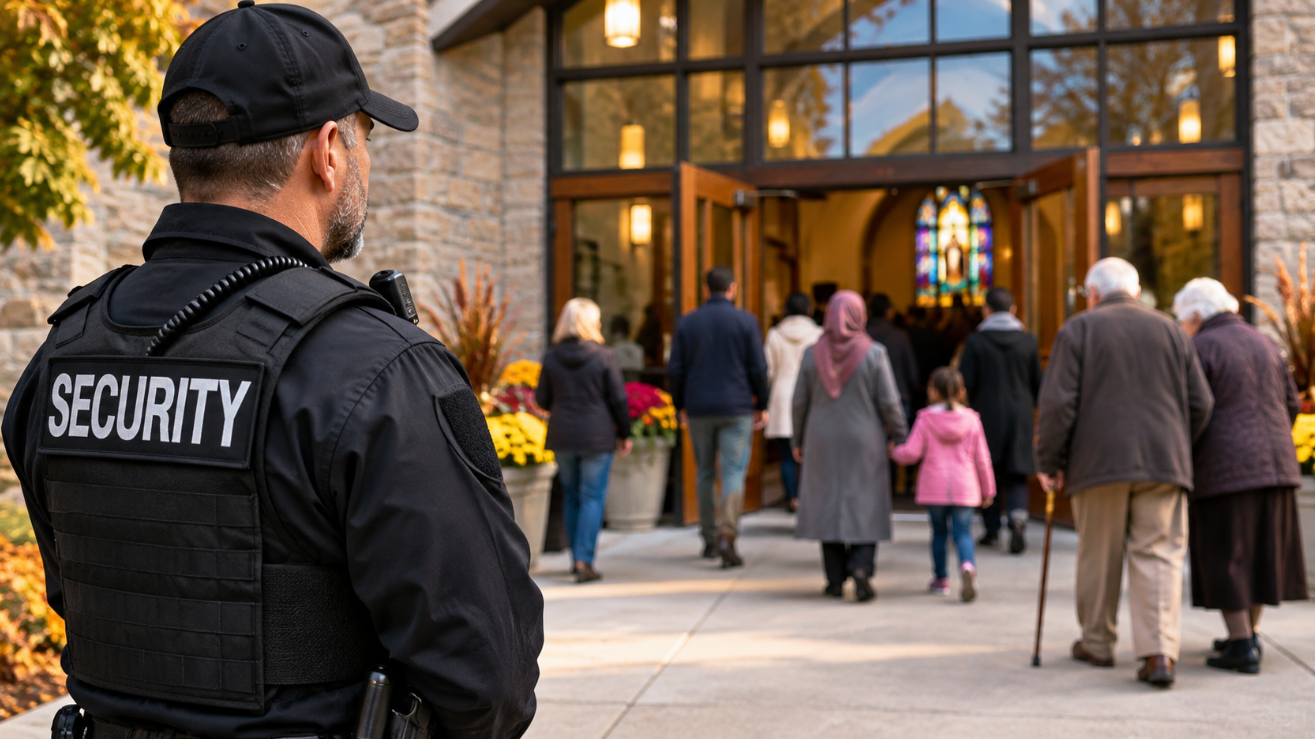
A place of worship exists to welcome people. Its security team must protect that openness while managing the risks that come with it. That tension makes faith and community security different from a conventional guarding assignment.
Churches, synagogues, mosques, temples, religious schools, and community centres are places of worship, learning, service, and connection. Their activities often involve children, seniors, volunteers, unfamiliar visitors, and members of the public. Attendance may fluctuate dramatically between ordinary weekdays, religious services, festivals, and special events.
For security professionals, success in these environments requires more than visibility, observation, and incident reporting. It requires sound judgment, cultural awareness, practical preparation, and the ability to respond proportionately without undermining the institution's welcoming character.
Effective security begins with understanding how an institution actually operates.
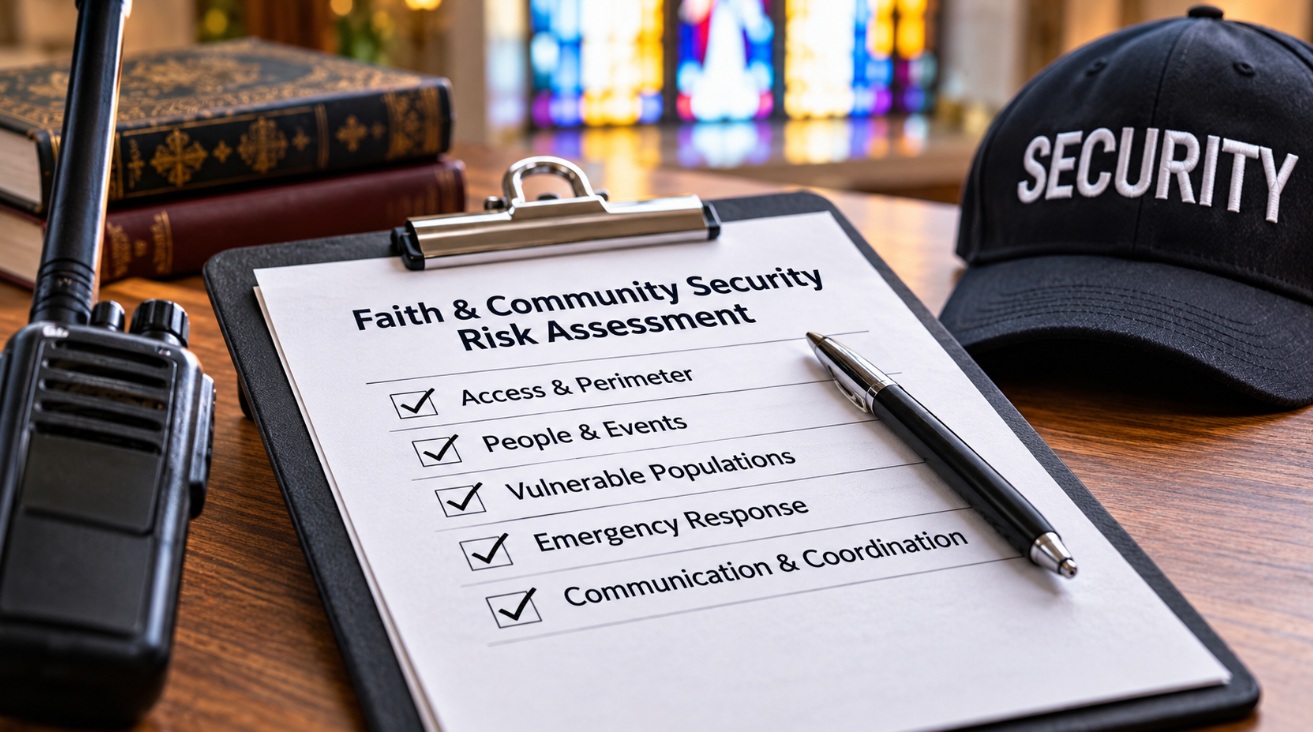
A conventional commercial risk assessment may emphasize property protection, theft prevention, and unauthorized entry. Faith and community institutions require these considerations, but their assessments must also account for worship schedules, public accessibility, volunteer involvement, vulnerable populations, and changing patterns of occupancy.
Security supervisors should work with institutional leadership to identify entrances, gathering areas, emergency exits, parking facilities, and locations where visitors may require assistance.
Risk assessments should consider credible threats, previous incidents, local conditions, and the consequences of service disruption. They should avoid assumptions based on the religious or cultural identity of the institution or its visitors.
A practical assessment should produce clear operational priorities: which entrances require supervision, how unusual behaviour will be reported, who makes decisions during an incident, and how security measures will change during major events.
The assessment should be reviewed when circumstances change, rather than treated as a one-time document.
Cultural Awareness and Access Management
Security personnel working in faith-based environments must understand that ordinary religious practices may be unfamiliar to them.
Appropriate conduct may involve respecting designated prayer areas, religious clothing, gender-specific spaces, dietary practices, sacred objects, or restrictions on photography.
Guards do not need to become experts in every religious tradition. They do, however, need an institution-specific orientation explaining expected conduct, important observances, and appropriate communication.
For example, an officer assigned to a place of worship should know whether certain areas are restricted during services, whom to approach with questions, and how to avoid interrupting ceremonies unnecessarily.
Supervisors should also reinforce impartiality. Security decisions must be based on observable behaviour, established procedures, and legitimate safety concerns—not appearance, ethnicity, religion, or personal assumptions.
Cultural competence strengthens both operational effectiveness and community trust.
Access management is especially challenging where institutions regularly welcome newcomers.
A heavily restrictive approach may discourage legitimate participation, while uncontrolled access can complicate emergency response and expose vulnerable areas.
The objective should be proportionate, clearly communicated access procedures.
During regular activities, this may involve a designated public entrance, discreet monitoring, and simple visitor guidance. During larger events, additional personnel may assist with queues, parking, crowd movement, and restricted-area access.
Security staff should distinguish between public spaces and areas requiring specific authorization, such as administrative offices, childcare rooms, storage facilities, and staff-only corridors.
Where visitor registration is necessary, procedures should be consistent, privacy-conscious, and appropriate to the actual risk.
“An effective officer should be capable of greeting a visitor respectfully, explaining an access requirement, and identifying a potential concern without treating every unfamiliar person as suspicious.”
This balance is central to community-oriented security.
De-escalation and Emergency Response
Faith and community institutions can experience emotionally sensitive situations involving family disagreements, distressed visitors, disruptive behaviour, or disputes over access and participation.
Not every disturbance represents a deliberate security threat.
Frontline personnel should be trained to recognize early indicators of escalating behaviour, maintain appropriate distance, communicate calmly, and seek assistance before a situation becomes unmanageable.
Useful techniques include listening without unnecessary interruption, providing clear choices, avoiding confrontational language, and moving discussions away from crowded or sensitive areas when safe.
Security officers should understand the limits of their authority and follow applicable law, employer policies, and site-specific instructions.
Where behaviour indicates an immediate threat, the priority shifts to protecting people, notifying emergency services, and following established response procedures.
Supervisors should reinforce that effective de-escalation is not a sign of weakness. Preventing an incident from escalating may be the most important intervention an officer makes.
Written emergency procedures are valuable only when people understand their responsibilities.
Institutions should establish practical arrangements for fire, medical emergencies, threatening behaviour, suspicious circumstances, severe weather, and other credible hazards.
Security personnel should know evacuation routes, accessible exits, assembly areas, emergency contact procedures, and the location of essential safety equipment.
Particular attention should be given to children, seniors, people with disabilities, and visitors who may not be familiar with the premises.
For larger gatherings, supervisors should consider crowd flow, emergency vehicle access, communication difficulties, and the possibility that an incident could occur during a religious ceremony or community event.
Training exercises should involve institutional representatives wherever practical. Even a short tabletop discussion can reveal gaps in decision-making, communication, and accountability.
Emergency plans should also identify when police, fire, or emergency medical services must be contacted. Security personnel should not be expected to perform duties beyond their training or lawful authority.
Practical Scenario
A Visitor at a Restricted Entrance
During a weekend service at a place of worship, a security officer notices a visitor approaching a side entrance designated for staff. The officer observes that the visitor appears frustrated but sees no indication of an immediate threat.
Keeping a respectful distance, the officer introduces himself and explains that public entry is through the main entrance. The visitor raises his voice, saying the main entrance is crowded. Rather than arguing, the officer acknowledges the inconvenience and offers to guide him to the correct entrance.
As the exchange attracts attention, the officer discreetly notifies the designated site liaison, who confirms the entrance policy and offers assistance. The officer continues speaking calmly, avoids blocking the visitor unnecessarily, and gives clear options. The visitor agrees to proceed to the main entrance.
Had the visitor made threats, attempted forced entry, or presented an immediate danger, the officer would have followed the site's emergency procedures and requested police assistance as warranted. After the incident, the officer documents observable facts, informs the supervisor, and recommends reviewing signage and queue management.
This hypothetical situation illustrates proportionate access control, de-escalation, coordination, and follow-up.
Building a Coordinated Security Program
A security program cannot operate effectively in isolation from the institution it serves.
Leadership should identify a designated security liaison with authority to communicate operational changes, clarify policies, and coordinate incident responses.
Security supervisors should establish regular briefings covering upcoming events, attendance expectations, access changes, volunteer responsibilities, and any credible safety concerns.
Clear reporting procedures are equally important. Incident reports should be factual, objective, timely, and limited to relevant information. Sensitive personal information must be handled in accordance with applicable privacy obligations.
Volunteer greeters, ushers, and event coordinators may notice emerging concerns before security personnel do. They should know how to report observations discreetly, without being expected to investigate or confront individuals.
The strongest arrangements recognize that security officers and institutional volunteers have different responsibilities but share a common objective: maintaining a safe and welcoming environment.
Smaller congregations and community organizations may lack the financial resources for continuous professional security coverage.
This does not mean effective preparedness is beyond their reach.
A proportionate program might combine periodic professional risk assessments, written emergency procedures, volunteer awareness training, improved lighting, controlled access to sensitive areas, and targeted security coverage during higher-attendance events.
The emphasis should be on identifying the most consequential risks and allocating limited resources accordingly.
Security providers should avoid recommending expensive measures without explaining their purpose, limitations, and operational value.
Security Responder · Field Reference
Before the Doors Open
Seven Questions Every Security Professional Should Ask
Faith-based and community facilities present unique security challenges. Before beginning an assignment, make sure you can answer these seven questions.
- 1Know the site — Which entrances are public, which areas are restricted, and where are the emergency exits?
- 2Understand the community — Are there religious practices, cultural considerations or scheduled activities that affect your duties?
- 3Identify the risks — What credible threats, previous incidents or site-specific vulnerabilities should you know about?
- 4Clarify authority — Who is your institutional contact, and what decisions can you make independently?
- 5Prepare to de-escalate — How will you manage a disruptive individual without unnecessarily interrupting worship or community activities?
- 6Know the emergency plan — Where are the assembly areas, emergency equipment and accessible exits? When should emergency services be called?
- 7Establish communications — How will you report concerns, request assistance and coordinate with staff or volunteers?
Effective security protects more than the premises. It protects the community's ability to gather safely.
A Specialized Responsibility
Faith and community security should be recognized as a distinct professional assignment requiring appropriate training, supervision, and operating procedures.
Its success cannot be measured solely by the number of incidents prevented or reports completed. It must also be evaluated by whether people can continue to worship, learn, gather, and participate without unnecessary fear or disruption.
The most effective security presence is not necessarily the most imposing. It is the one that combines preparedness, professional judgment, cultural understanding, and respect for the community being protected.
For Canada's private security industry, developing these capabilities represents an important opportunity to strengthen professional standards while serving institutions whose openness is central to their identity.
GUARDS CANADA® is an Ontario-licensed security services company providing professional security services to commercial, institutional, and community clients. The company supports the development of risk-based security practices, professional training, and site-specific operating procedures. guardscanada.com
Legal Disclaimer
This article is provided for general information and professional education only. It does not constitute legal advice. Laws, regulations, licensing requirements and authorizations concerning security operations vary by jurisdiction and may change.
Security professionals and employers should verify current requirements directly with the appropriate provincial or territorial regulatory authority before carrying out security operations.